Hair Extensions for a Wedding: Types, Timing and Cost

Outdoor Wedding Makeup: A Heat-Proof Guide for Spain
November 14, 2026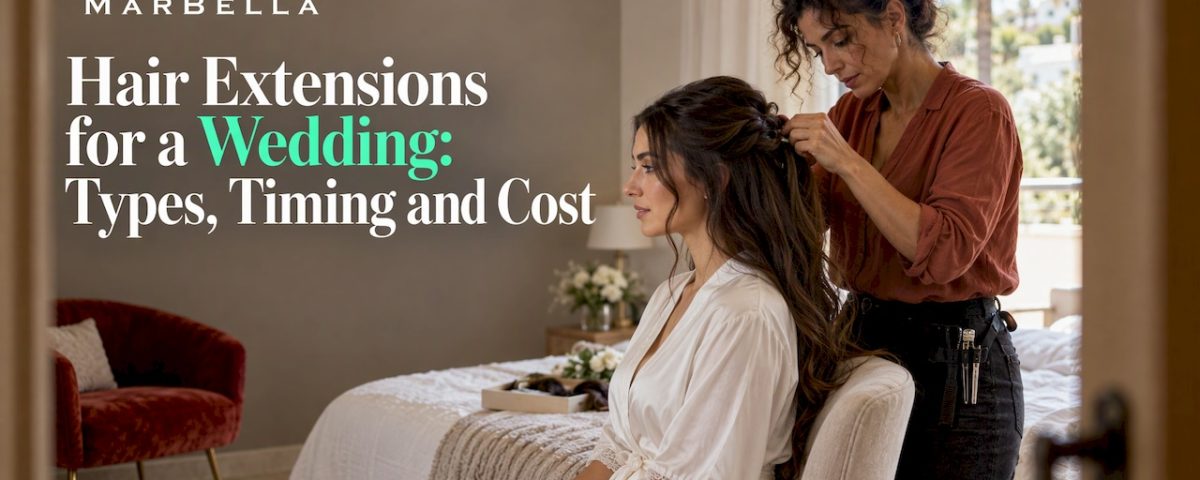
Hair extensions work for a wedding when they add what your hair cannot: length for a low chignon, fullness for waves, or enough body to hold a curl through a long day. The result looks natural when the type, the colour and the hairstyle are chosen together, fitted well ahead of the day and tried with your veil before the ceremony. We fit and remove extensions at your home, hotel or venue in Marbella, Estepona and the surrounding area, so the whole process can happen where you are getting ready.
TL;DR
- Extensions suit most bridal styles that need volume, length or a lasting curl. They help least with sleek, slicked-back looks or hair that is already long and thick.
- Choose the type by how long you want to wear them: clip-in pieces for the day itself, semi-permanent methods if you want them through the honeymoon too.
- Colour, length and texture must match your own hair. Plan any colour change before the extensions go in.
- Never wear extensions for the first time on the wedding day. Have them fitted weeks ahead and test the full look with your veil or headpiece.
- Quality professional extensions start at around 400 € in Spain, depending on method, density and length.
Table of Contents
- Do you actually need extensions for your wedding hair?
- Which type of extension suits a bride?
- Matching colour, length and texture
- Which hairstyles work with extensions
- When to start: a realistic timeline
- Keeping the style secure all day
- How much do bridal extensions cost in Spain?
- Get your wedding hair planned with us
- Caring for extensions before and after the wedding
- FAQ
- Sources
Do you actually need extensions for your wedding hair?
Not every bride does, and the honest answer depends on the hairstyle you have in mind. Wedding stylists quoted by The Knot disagree on the details, which is useful: one recommends extensions for most wedding hairstyles because they add volume and length and usually hold a curl better than natural hair, while another points out that they add little to many updos, especially slick-back styles, or for someone who already has long, dense hair.
A simple way to decide:
- You probably benefit if your hair is fine, shoulder length or shorter, loses its curl within an hour, or you want a full braid, a thick low ponytail or voluminous Hollywood waves.
- You probably do not need them if your hair is already long and thick, and your plan is a sleek, tight bun or a simple low knot.
- You may want a small amount if your hair is fine at the front or crown, or if your updo needs a little extra to make a chignon sit properly.
If you are undecided, the best test is to show a stylist photos of the looks you love and your hair as it is now. The right professional can tell you quickly whether the style needs help or not. Our guide to choosing wedding hairstyles in Marbella is a good place to gather ideas first.
Which type of extension suits a bride?
There are four families of extension you will hear about. They differ in how they attach, how long they last and how much fitting they need.
| Type | How it attaches | Best for | Wear time |
|---|---|---|---|
| Clip-in | Small clips you snap in and out | Adding volume or length for the wedding day only | One event, reusable for later occasions |
| Tape-in | Thin adhesive strips sandwiching your hair | Fine hair, flat and discreet wear, wedding plus honeymoon | Weeks to a few months, with re-tapes |
| Keratin bond | Small bonds made with keratin, a protein found in hair | Long wear, loose waves and curls | Several months with maintenance |
| Micro-link | Tiny beads with no glue or heat | Natural movement | Several months, longer to fit |
Clip-ins: for the day itself
Clip-ins are the usual choice when you only want extra volume or length on the wedding day. They go in and come out without affecting your natural hair, and they can be worn again for other events, such as a rehearsal dinner or a later party. They are also the easiest way to add a little extra at the crown, sides or nape for an updo.
Semi-permanent methods: for days or months
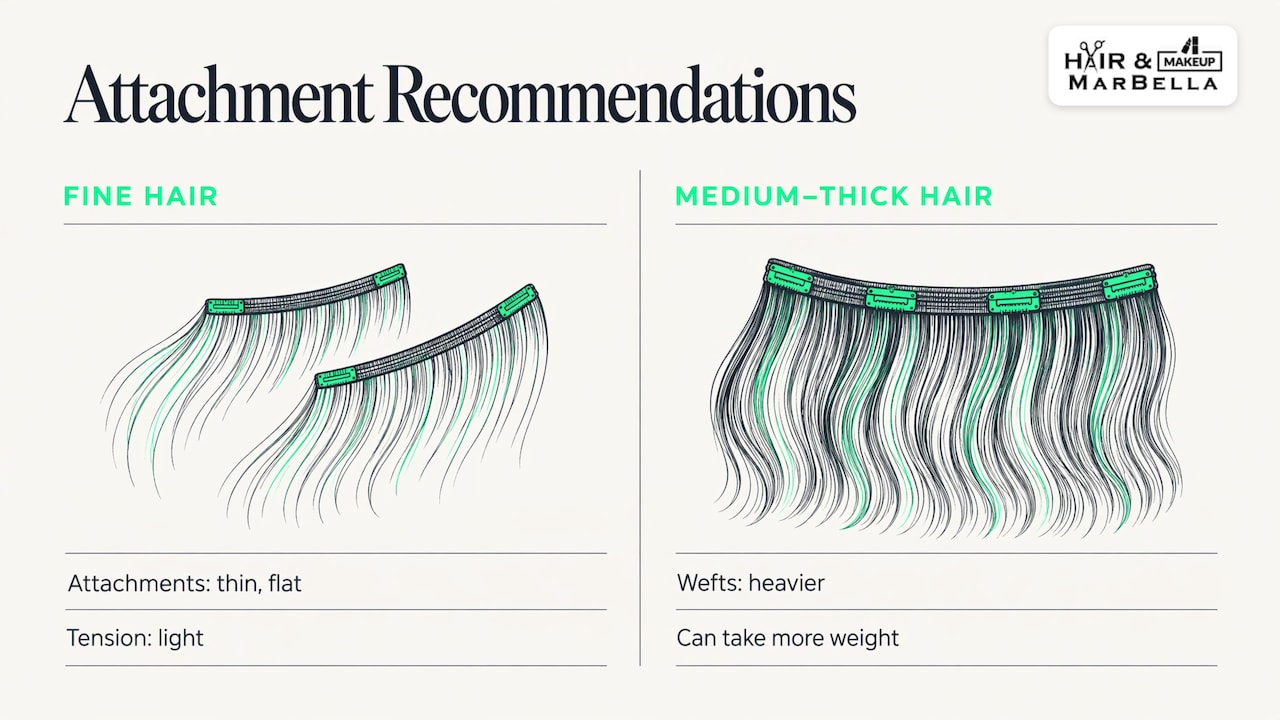
If you want the same hair for the ceremony, the reception and the honeymoon, a bonded or taped method gives you consistency. These need professional fitting and regular maintenance, and a stylist will recommend a method according to your hair density and how sensitive your scalp is. Fine hair generally does best with thin, flat attachments and light tension, while medium to thick hair can take heavier wefts.
Many brides end up with a mix: a few very discreet pieces around the face, a fine row through the back for width, and a shade blend that ties it together. The method is only the tool. What you are really ordering is the finished look.
If you would like to see what is available locally, our page on hair extension options on the Costa del Sol explains the choices, and the Marbella hair extensions page covers fitting and removal.
Matching colour, length and texture
The most common reason extensions look obvious in photographs is a poor match. Three things matter.
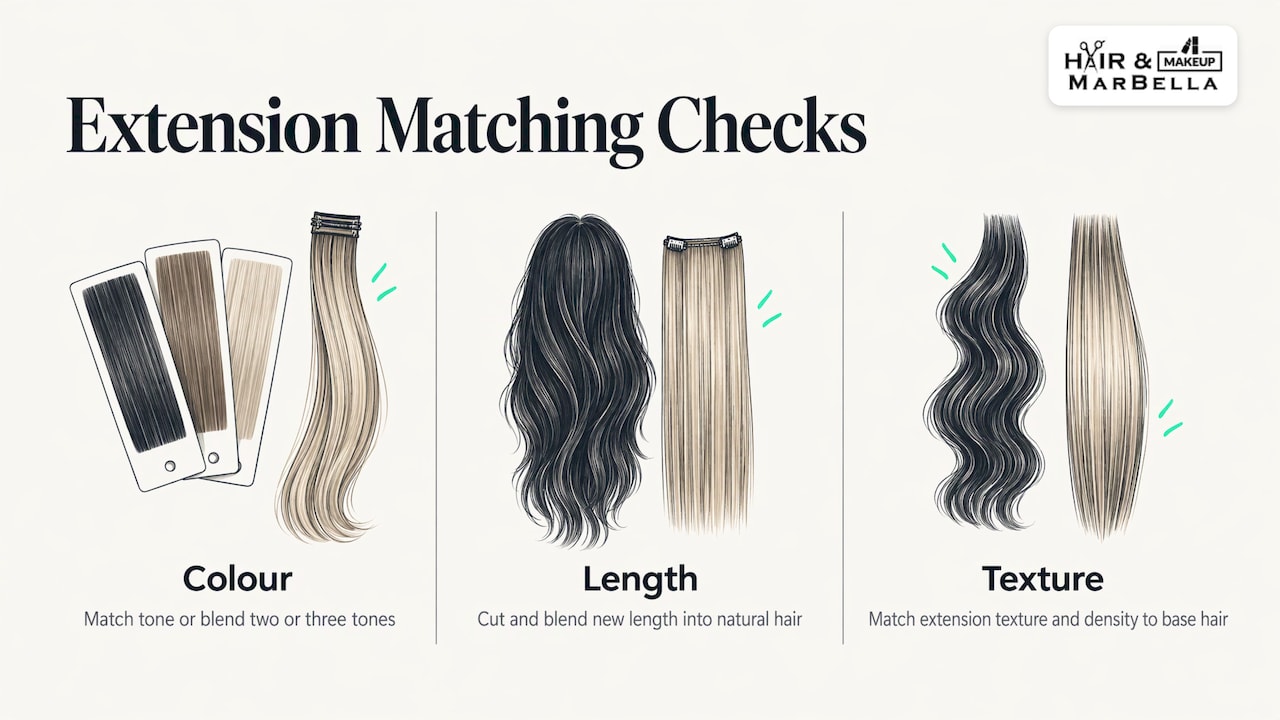
Colour. The shade should either be the same as your hair or deliberately create highlights, such as balayage or a sun-kissed effect. A Spanish hair expert interviewed by Harper’s Bazaar España notes that extensions can match your tone or be used to create these effects, and that blending two or three tones gives more volume and movement than one flat shade. If your own colour is faded, highlighted or grown out, the extensions need to reflect that, not just your root colour.
Length. More is not better. Extensions that are far longer than your hair make the join obvious and add weight. A stylist will usually cut and blend the new length into your own so there is no visible step, and will think about your height and dress when deciding how long the finished hair should be.
Texture and density. Straight extensions on naturally wavy hair, or thick extensions on fine hair, will not move together. The same Spanish expert advice in Elle España is to start by asking what you want to achieve, which method fits your everyday life and what your base hair is like: density, length and colour should suit that base hair.
If you are planning a colour change, such as lighter highlights for summer, do it before the extensions are chosen, so they are matched to the final shade and not to the old one.
Which hairstyles work with extensions
Most bridal styles can be built with extensions, but they do not all behave the same way.
- Loose waves and curls. The easiest and most forgiving. Extensions add length and body, and the curl holds longer.
- Half-up styles. Work very well, because the attachments sit underneath the lifted section.
- Braids. Extensions make a braid visibly fuller, which is a big gain for fine hair.
- Soft updos and chignons. Work well, but your stylist needs to know where the extensions are so they can be covered and pinned correctly.
- Very sleek, tight styles. The most demanding, because any irregularity can show. If this is your choice, test it carefully at your trial.
If you are also deciding on a look to go with your makeup, our wedding hair and makeup service in Marbella pairs both so the finish is coordinated.
When to start: a realistic timeline
Extensions are a project, not a last-minute add-on. A sensible plan looks like this:
- Three to four months before: consultation. Decide whether you want extensions for the day only or longer, check your density, and plan any colour change.
- Two to three months before: choose and order your extensions, so there is time to adjust colour or exchange them if needed.
- Six to eight weeks before: have them fitted if you are using a semi-permanent method, so you get used to the feel and weight.
- Two to three weeks before: hairstyle trial with the exact look: veil, hairpins, headpiece, earrings and your planned second style if you change for the party, such as a ponytail or loose waves.
- Wedding week: only a finishing touch and a blow dry.
Clip-ins have a shorter lead time, but the same principle applies. Wear them at least once before the day, even at home, so you are used to how they feel. A bride who tries them for the first time at her wedding has no chance to fix a colour mismatch or a pin that does not hold.
Bring photos of your dress, veil and headpiece to the trial, or the items themselves if you can. Arrive with clean, dry hair. A trial is also the moment to say which parts of the day matter most: a long church ceremony, outdoor photographs in the wind, a dance floor.
Keeping the style secure all day
A bridal look has to survive heat, hugs, wind and dancing. A few practical points make a large difference.
- Have your stylist place pins and clips in your natural hair next to the attachments, not directly on them. This reduces strain on the join.
- Dry your hair completely before styling. Damp hair under extensions is uncomfortable and makes them slip. Professionals recommend drying fully, working from top to bottom.
- Sleep with your hair tied up the night before and brush gently with a brush designed for extensions.
- Keep your second look simple. If you plan to change from an updo to loose waves for the party, tell your stylist at the trial so the placement works for both.
A mobile stylist can be especially helpful here, because the finish happens in the room where you are getting ready, so there is no travelling with a finished style. Our bridal hair service comes to your home, hotel or venue, and handles group bookings for your bridal party.
How much do bridal extensions cost in Spain?
Price depends on the method, the amount of hair (density), the length and the quality of the hair itself. According to Elle España, quality extensions applied by a professional average from around 400 € upwards, rising if you need more strips or greater length. The same piece also mentions packs of 20 adhesive strips at 99,90 €, which gives you a sense of how much the materials alone can vary from the final fitted cost.
Things that raise or lower the total:
- Number of wefts, strips or clips. Fine hair that needs a little fullness costs less than a full head of added density.
- Length. Longer hair needs more material.
- Method. Clip-ins that you wear once are different from a fitted method with maintenance appointments.
- Colour work. A multi-tone blend or custom colour is more work than a single shade.
- Maintenance. Fixed extensions usually need a touch-up every two to three months, so factor in any appointments if you want them beyond the wedding.
We do not publish a fixed price for extensions because the right quantity depends on your hair and the look you want. See our page on the cost of hair extensions in Estepona for how pricing is explained, then contact us with your date, location and a few photos.
Get your wedding hair planned with us
We have more than 14 years of experience providing mobile hair and makeup in Marbella and Estepona, and we fit and remove hair extensions as part of our services. For a bride that means the extensions, the hairstyle and the makeup can all be planned together and done where you are getting ready, whether that is a villa, a hotel or the wedding venue.
To plan your look, see our wedding hair and makeup page or get in touch through the Hair and Make up Marbella site with your wedding date, venue and a few photos of your hair and the styles you like.
Caring for extensions before and after the wedding
Good care makes extensions last, and makes them look better in your photographs.
- Brush morning and night with a comb or brush suitable for extensions, taking care at the joins to avoid tangles. Harper’s Bazaar España recommends a thorough brushing, plus washing and conditioning with gentle products.
- Condition from mid-lengths to ends, never directly on the attachment points.
- Do not sleep with wet hair.
- Book maintenance on time. Elle España reports expert advice not to go more than three to four months without maintenance, because of the risk of tangles, breakage or pulling.
- Store clip-ins properly. Fixed extensions usually need touching up every two to three months, whereas clip-ins can last several years if you look after them, so keep them clean and stored for your next event.
Our guide to the best hair care products for bridal hair covers what to use in the weeks before the wedding.
FAQ
Is it worth getting hair extensions for a wedding?
It is worth it if your hairstyle needs length, volume or a curl that lasts, which is common with fine or shoulder-length hair. If your hair is already long and thick and you plan a sleek, simple style, you may not need them. A short consultation with a stylist and photos of your chosen look will settle it.
What type of extensions are best for wedding hair?
Clip-ins suit a bride who wants extra volume or length on the day only. If you want the same hair through the honeymoon, a fitted method such as tape-in or keratin bonds is more practical. The best choice depends on your hair density, scalp sensitivity and hairstyle.
When should I try extensions before the wedding?
Start the consultation three to four months ahead, have fitted extensions in place six to eight weeks before, and do a full hairstyle trial two to three weeks before with your veil or headpiece. Never wear them for the first time on the wedding day.
How much do bridal hair extensions cost?
In Spain, quality extensions applied by a professional average from around 400 € upwards, according to Elle España. The final cost depends on the method, how much hair you need and the length.
Can bridesmaids and guests wear extensions too?
Yes. The same rules apply: match colour and texture, and try the look beforehand. We take group bookings for bridal parties, so everyone can be styled at the same location.
Sources
- The Best Hair Extensions for Wedding Hairstyles, The Knot
- ¿Cuánto cuesta ponerse extensiones en el pelo?, Elle España
- Extensiones de pelo: claves de experto para llevarlas bien, Harper’s Bazaar España